


How to Know If Your Digital Marketing Is Actually Working?
Marketing success is no longer about getting the most clicks, impressions, or followers. High-growth companies measure marketing by its contribution to leads, customers, revenue, profitability, and sustainable growth.
For businesses investing in SEO, Google Ads, Meta Ads, social media, and performance marketing, understanding the right metrics helps make better decisions and reduce wasted marketing spend.
1. Start With Business Goals
High-growth companies don’t start by asking how many leads they can generate. They start with the business objective.
For example:
Revenue Goal → Customers Needed → Opportunities Needed → Qualified Leads Needed → Marketing Budget
This creates a direct connection between marketing activities and business results.
2. Measure Customer Acquisition Cost (CAC)
Customer Acquisition Cost (CAC) shows how much a business spends to acquire one new customer.
CAC = Total Acquisition Cost ÷ New Customers
CAC can be measured by individual channels such as:
- Google Ads
- Meta Ads
- SEO
- Email Marketing
- Social Media
- Referrals
A channel generating cheap leads isn’t necessarily successful if those leads don’t become customers.
3. Measure Customer Lifetime Value (LTV)
Customer Lifetime Value estimates how much revenue a customer can generate throughout their relationship with a business.
LTV = Average Purchase Value × Purchase Frequency × Customer Lifespan
Comparing LTV with CAC helps companies understand whether their customer acquisition strategy is financially sustainable.
4. Focus on LTV
The LTV ratio compares customer value with acquisition cost.
For example:
- Customer LTV = ₹30,000
- CAC = ₹10,000
- LTV = 3:1
The right ratio varies by industry and business model, but the principle remains the same: customer value should justify acquisition investment.
5. Measure Qualified Leads, Not Just Lead Volume
Generating more leads doesn’t always mean better marketing.
A campaign generating 1,000 low-quality leads may perform worse than one generating 200 highly qualified leads.
Track:
- Qualified leads
- Lead-to-customer conversion
- Cost per qualified lead
- Opportunity conversion
- Revenue per lead
The focus should be on lead quality and commercial value.
6. Measure Pipeline and Revenue
For B2B businesses, leads are only one stage of the journey.
A stronger measurement framework is:
Leads → Qualified Leads → Opportunities → Pipeline → Customers → Revenue
Marketing teams should understand how much qualified pipeline and revenue their campaigns are helping generate.
7. Connect Marketing With Sales
Marketing and sales data should work together.
The complete journey can look like:
Advertisement → Website → Lead → CRM → Qualified Lead → Opportunity → Customer → Revenue
Connecting marketing platforms with CRM data makes it easier to understand which campaigns are actually producing customers.
8. Use Attribution Carefully
Customers often interact with multiple marketing channels before purchasing.
They may:
- See a Meta Ad
- Search on Google
- Visit the website
- Read a blog
- Contact the sales team
- Become a customer later
Attribution helps businesses understand the role different channels play throughout this journey.
The goal isn’t perfect attribution. The goal is better marketing decisions.
9. Measure Overall Marketing Efficiency
Businesses should look beyond individual campaign ROAS.
One useful high-level metric is:
MER = Total Revenue ÷ Total Marketing Spend
This provides a broader picture of how efficiently the overall marketing system is generating revenue.
10. Track CAC Payback
CAC payback shows how long it takes to recover the cost of acquiring a customer.
For example:
- CAC = ₹12,000
- Monthly contribution = ₹3,000
- Payback Period = 4 Months
Understanding payback helps businesses determine how quickly they can reinvest in growth.
11. Compare Channels by Customer Value
The cheapest lead source isn’t always the best channel.
A business should compare channels based on:
- Lead quality
- Conversion rate
- CAC
- Customer value
- Revenue
- ROI
- Retention
For example, How SEO can generate leads but paid advertising can produce customers with higher lifetime value.
12. Don’t Depend on Vanity Metrics
Metrics such as likes, impressions, followers, and clicks can be useful, but they shouldn’t be the main measure of growth.
Vanity Metrics
- Impressions
- Likes
- Followers
- Clicks
- Reach
Growth Metrics
- Qualified leads
- Customers
- CAC
- Revenue
- Pipeline
- LTV
- ROI
The key difference: vanity metrics show activity, while growth metrics show business impact.

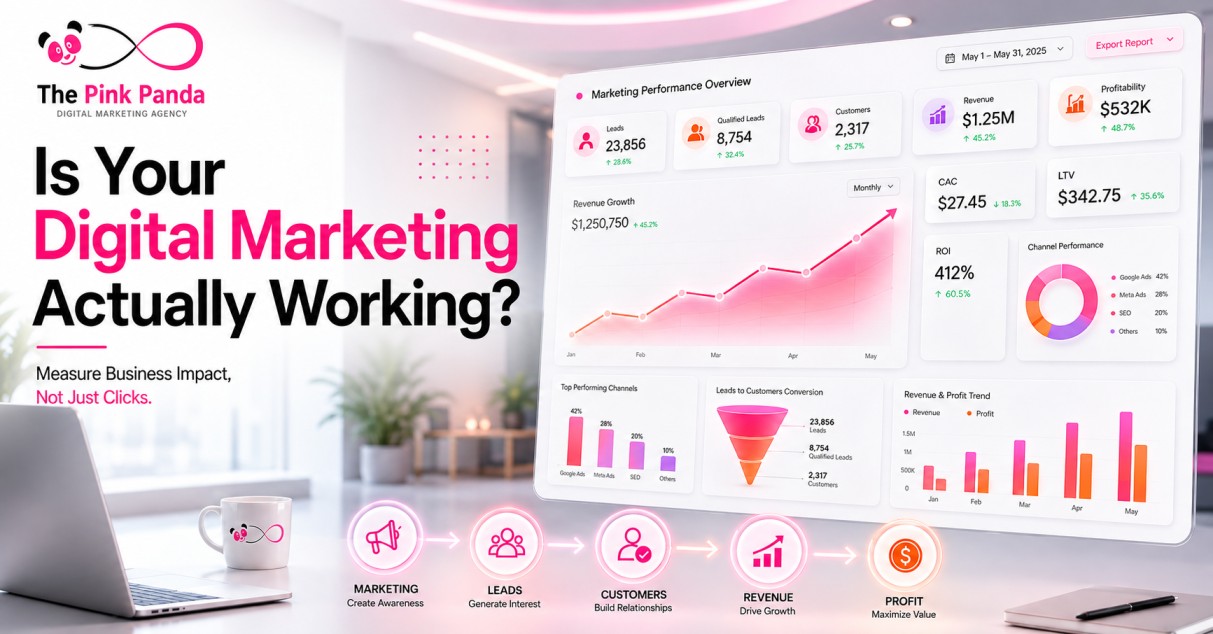
13. Build a Simple Marketing Dashboard
A practical dashboard can include:
Acquisition
- Leads
- Qualified leads
- CAC
- Conversion rate
Sales
- Opportunities
- Pipeline
- Customers
- Revenue
Profitability
- LTV
- LTV
- CAC payback
- ROI
Channel Performance
- Google Ads
- Meta Ads
- SEO
- Social Media
- Email Marketing
A good dashboard doesn’t need hundreds of numbers. It needs the right numbers that support better decisions.
How The Pink Panda Helps Businesses Measure Marketing
At The Pink Panda, digital marketing is focused on measurable business outcomes.
Our services include:
- SEO
- Google Ads
- Meta Ads
- Social Media Marketing
- Performance Marketing
- Content Marketing
- Conversion Optimization
- Analytics & Reporting
Instead of focusing only on how many people interacted with a campaign, we look deeper:
How many qualified leads were generated?
How many became customers?
What revenue was generated?
What did it cost to acquire those customers?
This creates a more meaningful connection between marketing activity and business growth.
Final Thoughts
High-growth companies don’t measure marketing by data volume. They measure it by business impact.
The most important journey to track is:
Marketing → Leads → Qualified Opportunities → Customers → Revenue → Profitability

The real question isn’t:
“How many people interacted with our marketing?”
It’s:
“Which marketing activities are creating profitable and sustainable growth?”
That’s how high-growth companies actually measure marketing.
FAQs
1. What is the most important marketing metric?
There is no single metric for every business. CAC, LTV, revenue, qualified leads, conversion rate, and ROI should be measured according to business goals.
2. Is ROAS enough to measure marketing success?
No. ROAS is useful for advertising performance, but businesses should also consider CAC, LTV, profit margins, and overall ROI.
3. What is the difference between CPL and CAC?
CPL measures the cost of generating a lead, while CAC measures the cost of acquiring an actual customer.
4. Why is LTV important?
LTV helps businesses understand the long-term value of customers and determine whether acquisition costs are sustainable.
5. Should businesses track likes and impressions?
Yes, but mainly as supporting metrics. Revenue, customers, qualified leads, CAC, and ROI should receive greater importance when measuring business growth.
6. How can small businesses measure marketing?
Start with a simple funnel:
Marketing Spend → Leads → Qualified Leads → Customers → Revenue → CAC
As the business grows, additional metrics such as LTV, attribution, retention, and ROI can be added.