

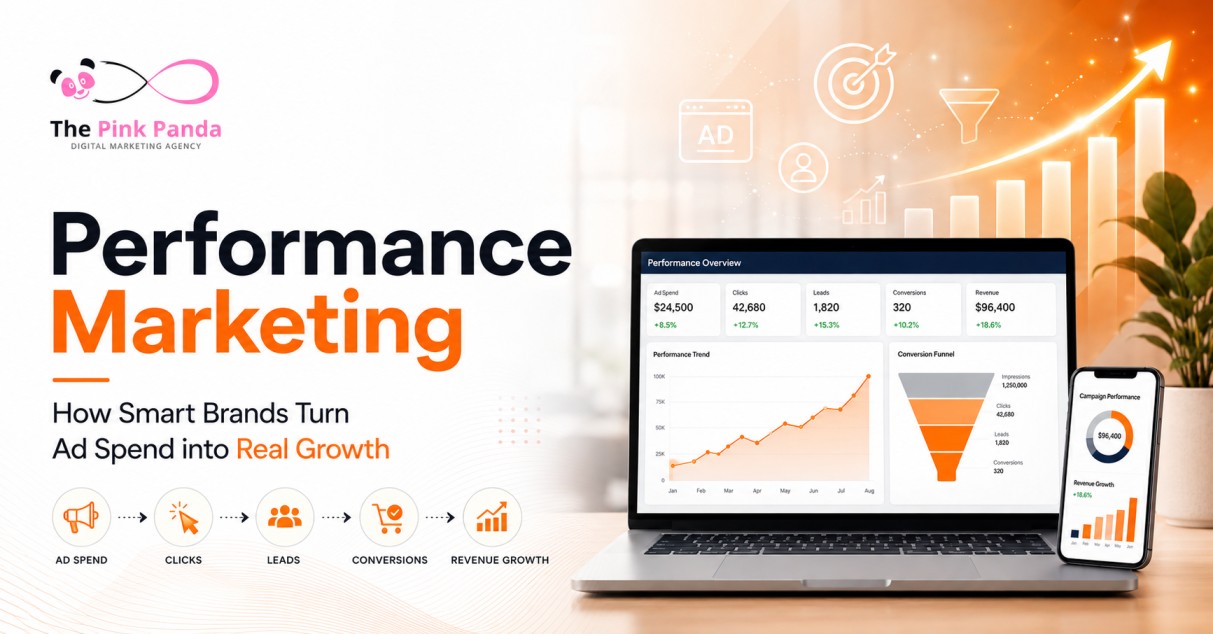
Performance Marketing : How Smart Brands Turn Ad Spend into Real Growth
Clicks are easy to buy. Customers are not.
In a digital world where businesses compete for attention across Google, Instagram, YouTube, websites, marketplaces, and AI-powered search, simply running ads is no longer enough.
The real question is:
“Is our marketing actually generating business?”
That is where performance marketing makes a difference.
Performance marketing focuses on measurable outcomes such as leads, sales, enquiries, bookings, app installs, and revenue. Instead of judging success only by impressions or likes, businesses can connect their marketing efforts to actions that matter.
What is Performance Marketing?
Performance marketing is a results-driven approach to digital marketing where campaigns are planned, tracked, tested, and optimized around specific business goals.
Depending on the business, the goal could be:
- Generating qualified leads
- Increasing online sales
- Getting more enquiries
- Driving website conversions
- Increasing bookings
- Reducing customer acquisition costs
- Improving return on advertising spend
Platforms such as Google Ads, Meta Ads, YouTube Ads, affiliate marketing, and other digital advertising channels can all form part of a performance marketing strategy.
The key difference is simple:
Don’t just measure attention. Measure action.
Google’s own conversion-tracking guidance emphasizes measuring valuable actions such as sales, leads, calls, sign-ups, and downloads rather than stopping at clicks.
Why Performance Marketing Matters at the peak of Festive Time?
Digital advertising is becoming more competitive, while customer journeys are becoming less predictable.
People may discover a brand through Instagram, compare it on Google, watch a YouTube video, read reviews, visit the website, and finally convert days or weeks later.
At the same time, AI is changing campaign optimization, first-party data is becoming increasingly important, and marketers are moving toward measurement that connects campaigns with actual business outcomes.
This means modern performance marketing is no longer just about “running ads.”
It is about building a measurable growth system.
5 Performance Marketing Trends Shaping Sales
1. AI Is Changing Campaign Optimization
AI-powered advertising tools are increasingly handling bidding, audience optimization, campaign delivery, and creative variations.
But AI is only as effective as the data and strategy behind it.
The competitive advantage is shifting toward marketers who can provide better conversion signals, stronger creative assets, and clearer business objectives.
2. First-Party Data Is Becoming More Valuable
Businesses are paying greater attention to data they collect directly through their websites, CRM systems, apps, email lists, and customer interactions.
Why?
Because relying entirely on external audience signals makes measurement and targeting more challenging.
A strong first-party data strategy can help businesses understand their customers better while supporting more privacy-conscious marketing.
3. Creative Is a Performance Tool
A beautiful advertisement is not automatically a high-performing advertisement.
In 2026, creative testing is becoming increasingly important.
Brands should test:
- Different hooks
- Short-form videos
- Static creatives
- User-generated content
- Different offers
- Headlines
- Calls-to-action
- Customer pain points
The winning creative is the one that helps move the audience toward action.
4. Full-Funnel Measurement Matters
Looking only at CPC, CTR, or CPL can give an incomplete picture.
Imagine one campaign generates 100 leads at ₹200 each, while another generates 30 leads at ₹500 each.
At first glance, the first campaign looks better.
But what if the first campaign generates only two customers while the second generates ten?
Suddenly, the story changes.
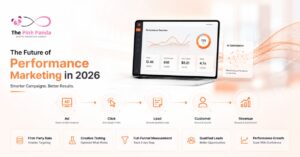
That is why businesses need to look beyond leads and understand the journey:
Ad → Click → Lead → Qualified Lead → Customer → Revenue
5. Quality Is Becoming More Important Than Volume
The cheapest lead isn’t always the best lead.
Performance marketing should focus on attracting people who have a genuine need, buying intent, and potential to become customers.
This is why marketers increasingly need to connect advertising platforms with CRM and sales data instead of judging campaigns only by platform-reported numbers.
The Most Important Performance Marketing Metrics
Different businesses need different KPIs, but some of the most useful include:
CPC – Cost Per Click
How much you pay for each click.
CPL – Cost Per Lead
How much it costs to generate a lead.
CPA – Cost Per Acquisition
The cost of acquiring a customer or completed conversion.
Conversion Rate
The percentage of visitors or clicks that complete the desired action.
ROAS – Return on Ad Spend
How much revenue is generated for every unit of advertising spend.
CAC – Customer Acquisition Cost
The overall cost involved in acquiring a customer.
But remember:
A dashboard full of numbers does not automatically mean you have a performance strategy.
The numbers need to lead to better decisions.
How to Build a Performance Marketing Strategy
A strong performance marketing system can follow five simple steps:
1. Define the Business Goal
Know exactly what you want: leads, sales, bookings, revenue, or another measurable outcome.
2. Understand Your Audience
Identify their needs, challenges, buying behaviour, interests, and decision-making process.
3. Create the Right Campaign
Choose the appropriate platform, audience, creative, offer, landing page, and conversion goal.
4. Track Everything That Matters
Use conversion tracking, analytics, UTM parameters, CRM data, and other appropriate measurement tools.
5. Test, Learn & Optimize
Performance marketing is never truly “finished.”
Test new creatives, audiences, messaging, landing pages, offers, and budgets. Then use the data to decide what deserves more investment.
Why Choose The Pink Panda for Performance Marketing?
At The Pink Panda, we believe performance marketing should be about more than generating clicks or filling a spreadsheet with leads.
Our approach focuses on connecting:
Strategy + Creative + Advertising + Data + Conversion + Optimization
From Meta Ads and Google Ads to SEO, landing pages, analytics, and remarketing, we look at the complete customer journey.
Because the goal isn’t simply to make your campaign look busy.
The goal is to make your marketing work harder for your business.
Final Thoughts
Performance marketing is evolving quickly.
AI is changing optimization. First-party data is becoming more important. Creative is becoming a stronger performance lever. And businesses are looking beyond clicks and leads toward actual revenue and customer value.
The brands that win will not necessarily be the ones spending the most.
They will be the ones measuring better, testing faster, understanding their customers, and continuously improving.
Because in performance marketing, the real KPI isn’t activity. It’s growth.

Frequently Asked Questions
1. What is performance marketing?
Performance marketing is a results-focused digital marketing approach where campaigns are measured against actions such as leads, sales, bookings, enquiries, or revenue.
2. Is performance marketing the same as digital marketing?
Not exactly. Digital marketing is a broad category that includes SEO, social media, content marketing, email marketing, paid advertising, and more. Performance marketing focuses specifically on measurable outcomes.
3. Which platforms are used for performance marketing?
Common platforms include Google Ads, Meta Ads, YouTube Ads, affiliate platforms, and other paid digital channels.
4. What is the most important performance marketing metric?
There is no single metric for every business. Depending on the objective, CPL, CPA, conversion rate, ROAS, CAC, qualified leads, and revenue can all be important.
5. Can small businesses use performance marketing?
Yes. Performance marketing can work for businesses of different sizes because campaigns can be launched with controlled budgets and optimized based on measurable results.
6. Does performance marketing guarantee sales?
No. Performance marketing improves measurement and optimization, but results also depend on factors such as the product, pricing, offer, website, competition, sales process, and market demand.
7. Why is tracking important in performance marketing?
Tracking helps businesses understand which campaigns and marketing activities are contributing to valuable actions such as leads, sales, and conversions.