
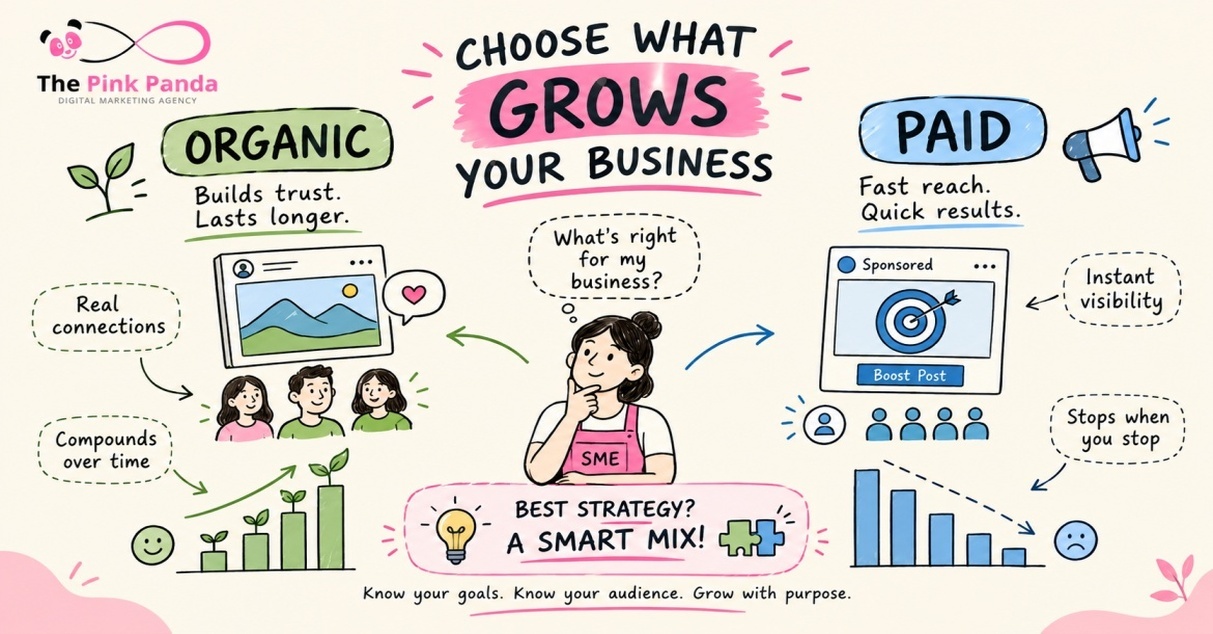
Organic versus paid: choosing the right social media in marketing strategy for SMEs
Introduction
Many Indian SMEs make two common mistakes with social media. They either post consistently on Instagram and collect plenty of likes but zero leads, or they run paid ads without a content foundation and burn through the budget with little to show for it. Neither approach works in isolation.
At The Pink Panda, a full-service digital marketing agency based in Gurgaon, we work with startups and SMEs across Delhi NCR, and the brands that generate real, measurable results are the ones that combine organic and paid social deliberately, not randomly.
This article shows how social media in marketing should be sequenced: organic to validate, paid to amplify. You will learn how to pick the right platforms, build organic content that converts, sequence paid amplification, work with micro-influencers on a sensible budget, and execute a 90-day plan with KPIs you can track from day one.
1, Picking the right social media platforms (not all of them)
Platform choice is the first decision that determines whether your social media marketing strategy generates leads or wastes time. The most common mistake SMEs make is trying to be everywhere at once, producing diluted content across five channels instead of building authority on two.
Which platforms Indian audiences actually use
India’s social media landscape is large and segmented by age, geography, and intent. Instagram has roughly 350–480 million users (as of mid-2026, per DataReportal), skewing 18–34 and predominantly urban, making it the primary platform for D2C and lifestyle brands. Facebook’s roughly 314–400 million users lean toward the 25–50 age group and include strong Tier-2 and Tier-3 audiences. YouTube reaches roughly 450–500 million users across age groups and is particularly powerful for research-led purchases where trust matters before a transaction. LinkedIn has around 150–170 million members, predominantly B2B professionals in metro areas, while WhatsApp, with roughly 487–535 million users, is the highest converting channel for repeat buyers across every tier of the country.
Matching platform to your business type
B2C product brands should prioritise Instagram and YouTube. Local service businesses get better returns from Facebook and WhatsApp, particularly for non-metro audiences where Facebook communities remain highly active. B2B SaaS and consulting firms should concentrate on LinkedIn for job-title targeting and professional lead generation. If your business targets regional-language customers in Tier-2 or Tier-3 markets, layering Facebook and WhatsApp will outperform a sole reliance on Instagram.
Why social media in marketing needs sequencing, not spreading thin ?
Consistency on two to three platforms typically outperforms a diluted presence across many channels. Ask yourself three questions before finalising your platform shortlist: Where does your buyer actually spend time? Which formats can your team realistically produce each week? And which platform’s ad targeting maps most precisely to your customer segment? Answer those and your shortlist writes itself. Once you have traction on two channels, adding a third becomes a low-risk expansion rather than a distraction.
2, Organic content that builds real traction
Organic social media for business is not about going viral. It is about building a publishing system that generates consistent reach, saves, and qualified enquiries over a sustained period. The goal in the first 90 days is reliable output, not a one-off spike.
Short video, carousels, and what each format actually delivers
On Instagram, Reels achieve roughly 36% more reach than carousels, but carousels generate around 12% more engagement, per Socialinsider’s 2025 benchmarks. LinkedIn document carousels deliver the highest professional engagement across major platform-format combinations. YouTube Shorts drive subscriber acquisition while long-form video builds the trust needed for higher-consideration purchases. The practical recommendation: use Reels or Shorts for discovery, carousels for saves and shares, and long form video for authority and conversion. These are not competing formats; they serve different stages of the same funnel.
Content pillars that give you a structured calendar
A pillar framework gives your calendar structure without making every post feel forced. Choose three to five recurring themes: product education, social proof, lifestyle or inspiration, brand story, and offers. A workable starting content mix is 40% education or inspiration, 25% proof, 15% promotional, and 20% reactive or community-driven content. For Instagram specifically, a sustainable weekly cadence looks like three Reels, one carousel, one product or proof post, and daily Stories. That volume is achievable for a small team and delivers the consistency that both algorithms and audiences reward.
3, Paid social media in marketing: when to start spending and how much
Paid social media advertising is an amplifier of what organic has already validated, not a replacement for it. Run organic for the first 30 days, identify which posts generate the strongest reach and engagement, and then back the winners with a budget. Starting paid before organic validation is how SMEs waste money on creative that was never proven to resonate.
India benchmarks for Meta, LinkedIn, and YouTube ads
Always evaluate CPL alongside your lead-to-customer rate before drawing conclusions about which platform is actually cheaper.
Budget allocation logic for early-stage SME campaigns
One practical starting framework is to allocate 70% of your paid budget to your primary platform (Meta for most B2C brands), 20% to retargeting, which earns a larger share because warm audiences consistently convert at a lower CPL than cold ones, and 10% to testing a secondary channel. Increase spend only after establishing a positive CPL baseline from real campaign data, not from industry averages or assumptions about creative quality.
4, Influencer partnerships on an SME budget
Influencer marketing is not reserved for large brands. Indian SMEs can build social proof and reach targeted local audiences through micro-influencer partnerships at costs that make commercial sense for a business watching every rupee of marketing spend.
Micro vs macro: which makes more sense for a startup
Macro influencers offer reach, but they rarely offer the niche specificity that drives conversions for an SME. Micro-influencers with 10,000–100,000 followers in focused categories such as fitness, food, parenting, or local lifestyle typically deliver engagement rates of 3%–7% on Instagram, with strong performing creators reaching 5%–8%. That trust and audience relevance is more commercially valuable to a startup than broad but shallow visibility across an audience that has no particular reason to buy.
What to brief, what to track, and what to pay
An influencer brief should cover audience fit, content format, key message, disclosure requirements, and usage rights. The KPIs that matter are reach, engagement rate, story swipe-ups or link clicks, WhatsApp enquiries, and coupon redemptions. UTM links and unique discount codes are non-negotiable tracking minimums before any influencer campaign goes live.
5, Your 90-day social media plan and the KPIs to track
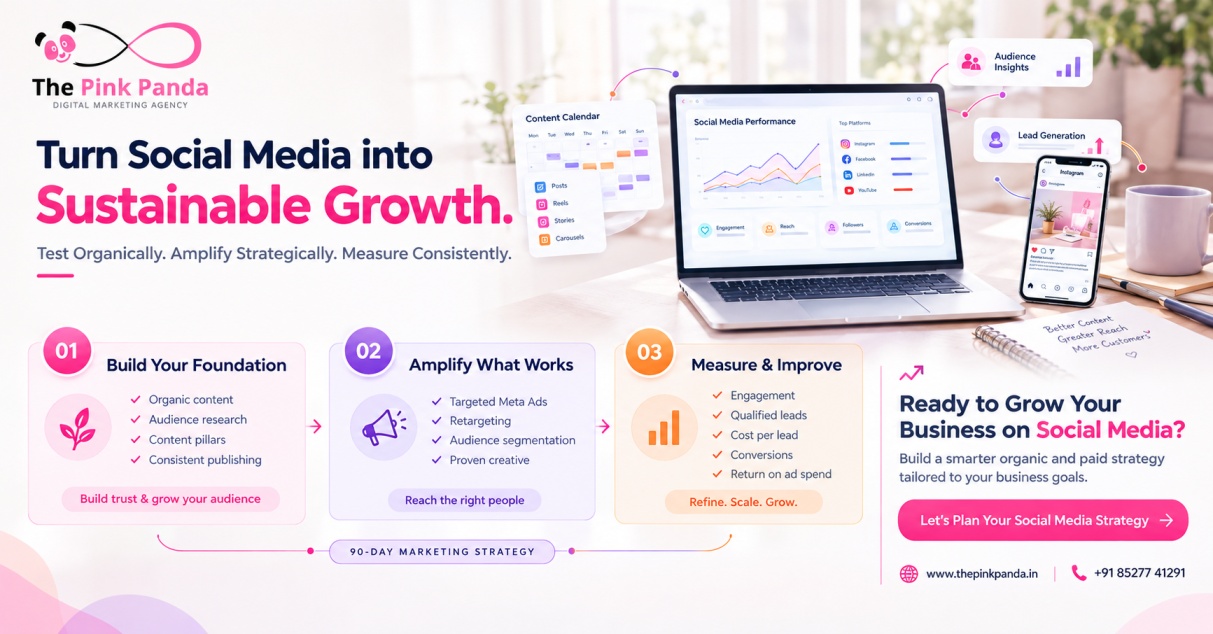
This is a repeatable system designed to move your brand from awareness to qualified leads to conversions within three months, with measurable checkpoints at each stage. Treat it as a framework you adapt, not a rigid schedule you follow blindly.
Days 1–30: audit, baseline, and launch
The setup phase is about measurement before output. Audit existing analytics, record baseline metrics including reach, engagement rate, CTR, and CPL, fix bios and tracking pixels, define one primary audience segment, and establish your content pillars. Launch at a cadence your team can sustain week after week. The Day-30 checkpoint is straightforward: keep the two best-performing formats and cut consistently weak ones. Drop what is not working before Month 2 begins, carrying it forward costs time without a return.
Days 31–60: test organic and launch paid
Run controlled content tests: hook versus hook, short versus long video, founder-led versus creator-led content. Change one variable at a time and compare against your Month 1 baseline so results are actually interpretable. Launch your first paid Meta campaign using the best-performing organic content as your creative input. The Day-60 checkpoint is to reallocate budget toward whichever platform and audience combination is delivering the lowest qualified CPL.
Days 61–90: amplify winners and measure ROI
Repurpose top organic posts into paid creative, retarget engaged audiences and site visitors, and add stronger CTAs across every stage of your funnel. Connect your social reporting to actual business outcomes: leads, revenue, and cost per acquisition. The KPI scorecard spans five areas: awareness (reach, impressions, follower growth rate); consideration (engagement rate, saves, link clicks); leads (form submissions, WhatsApp enquiries, cost per qualified lead); conversions (purchases, ROAS, cost per acquisition); and retention (repeat orders, response time). Reviewing these monthly gives you the data to make confident decisions rather than reactive ones.
6, What a real campaign delivered, and your next step
Frameworks are useful. Numbers from actual campaigns are more convincing. The Pink Panda runs Meta campaigns for startups and SMEs in Delhi NCR.
The campaign setup and what the first 30 days showed
The Pink Panda runs campaigns on Instagram and Facebook.
Talk to The Pink Panda about your social media strategy
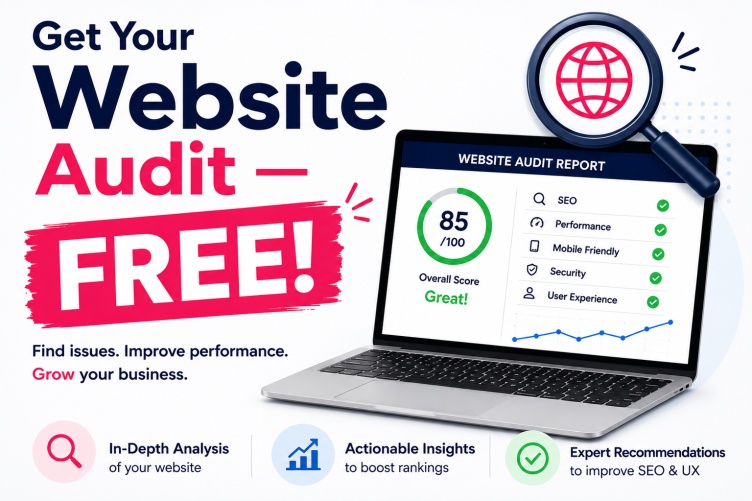
If you are an SME in India looking to build or sharpen your social media marketing strategy, get in touch with The Pink Panda. We will review your current platform mix, content performance, and paid ad efficiency, and give you a clear picture of what is working and what to fix first. Contact our team to discuss what an audit would look like for your business.
The right question is sequencing, not choosing sides
The organic versus paid debate is the wrong frame for an SME. The right question is how to sequence them: organic first to validate what resonates, paid to amplify what works. For SMEs, social media in marketing is most effective when organic content is tested first and paid spend follows the evidence. Every step should connect to a measurable outcome, moving prospects from targeted exposure to trackable enquiries and sales. Pick two platforms, define five content pillars, set your baseline KPIs, and launch your 90-day plan. Review performance monthly rather than reacting daily, and let data drive your budget decisions rather than guesswork. The system works, but only consistent execution makes it so. Once the framework is in place, there is nothing complicated about it.
Conclusion
Organic and paid social media marketing work best when they complement each other. Organic content helps build trust and identify what resonates with your audience, while paid advertising amplifies successful content and reaches new customers.
Start with two or three relevant platforms, establish clear content pillars, define measurable KPIs, and follow a 90-day plan.
Test organically. Amplify strategically. Measure consistently. Grow sustainably.
Frequently Asked Questions (FAQs)
1, What is the difference between organic and paid social media marketing?
Organic marketing uses unpaid content to build brand awareness and trust, while paid marketing uses advertisements to reach targeted audiences and generate leads or sales.
2, Which social media platform is best for SMEs?
Instagram suits B2C brands, LinkedIn supports B2B businesses, Facebook helps local businesses, YouTube builds trust through videos, and WhatsApp supports customer communication.
3, Should businesses focus on organic or paid social media marketing?
Combining both is often effective. Organic content helps identify what resonates with audiences, while paid advertising amplifies successful content.
4, When should a business start running social media ads?
Businesses can begin by testing organic content for approximately 30 days, then use the best-performing posts to guide paid campaigns.
5, How can businesses measure social media marketing success?
Track reach, engagement, website clicks, qualified leads, cost per lead, conversions, return on ad spend, and repeat purchases.
6, How can The Pink Panda help businesses with social media marketing?
The Pink Panda helps startups and SMEs improve their social media strategy by reviewing platform selection, content performance, and paid advertising efficiency. Visit www.thepinkpanda.in to learn more.
#OrganicVsPaidMarketing #SocialMediaMarketing #DigitalMarketing #SocialMediaStrategy #MarketingForSMEs #PaidSocialMedia #OrganicSocialMedia #LeadGeneration #InfluencerMarketing #SmallBusinessMarketing #ThePinkPanda #GurgaonDigitalMarketing