


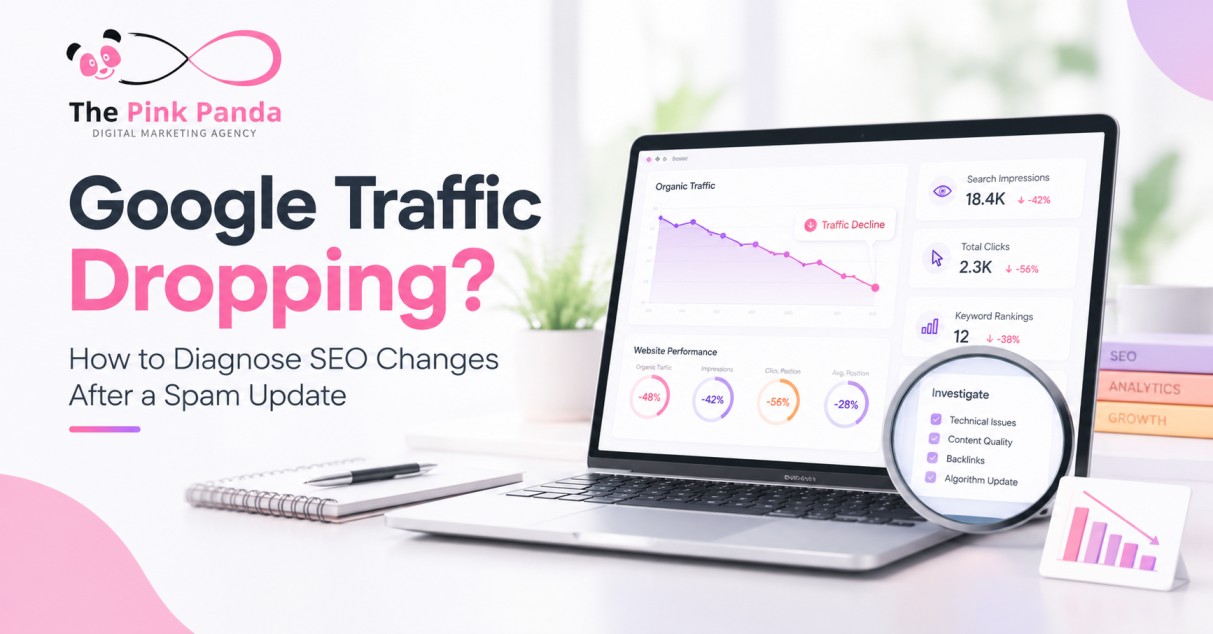
Google Traffic Dropping? How to Diagnose SEO Changes After the Latest Spam Update
A sudden drop in Google traffic can be stressful for any business. Your website may have been generating consistent visitors, leads, and enquiries, but now your rankings are slipping, and fewer people are finding your pages.
One possible reason is a Google Search spam update. However, not every traffic decline is caused by an algorithm update. Technical issues, changing search demand, content quality, and increased competition can also affect your website’s performance.
The key is to identify the real cause before making major SEO changes. Here is how to diagnose a traffic drop and build a recovery strategy.
1. Confirm Whether a Google Spam Update Is Responsible
Before changing your SEO strategy, check whether Google has announced a recent spam update. Compare the announcement date with the period when your website traffic started declining.
Use Google Search Console to review clicks, impressions, average position, and affected pages. Compare the performance before and after the suspected update.
If traffic dropped around the same time as an announced update, investigate further. Remember, timing alone does not prove that the update caused the decline.
2. Analyse Your Traffic in Google Search Console
Google Search Console is one of the most useful tools for diagnosing organic search performance.
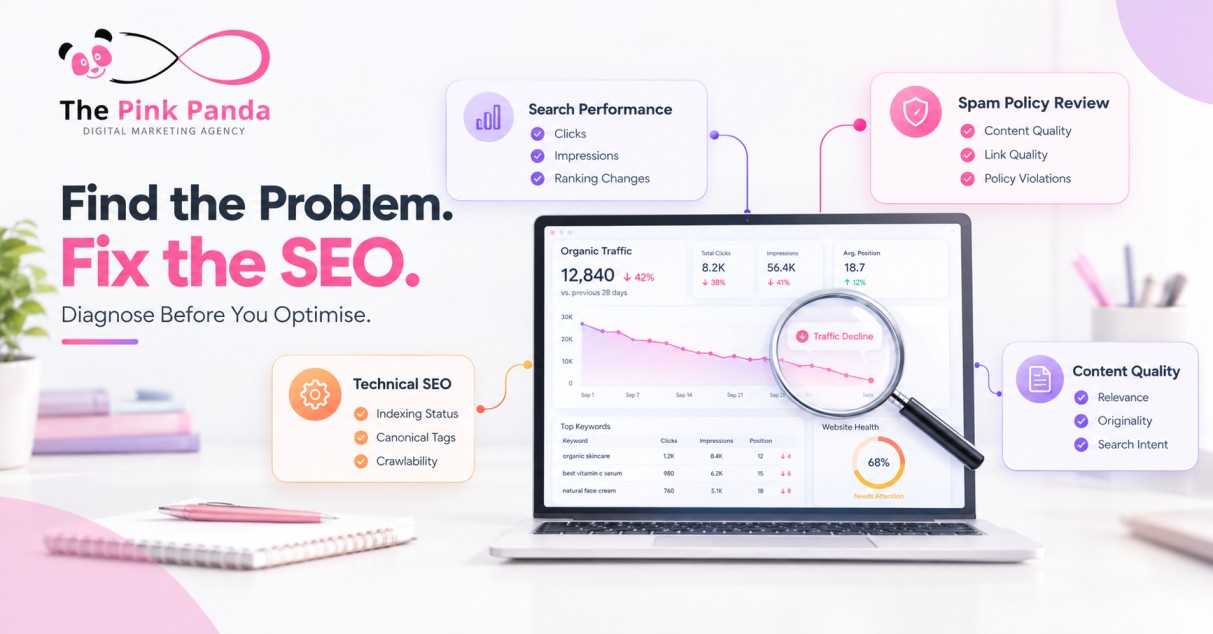
Focus on these areas:
- Clicks: Are fewer users visiting your website from Google?
- Impressions: Are your pages appearing less frequently in search results?
- Average position: Have your important keywords lost rankings?
- Pages and queries: Which URLs and search terms are experiencing the biggest decline?
Compare similar time periods and account for normal weekly or seasonal fluctuations. This helps you distinguish a genuine SEO issue from temporary changes in search demand.
3. Check for Spam-Related SEO Issues
Google’s spam policies target practices designed to manipulate search rankings rather than genuinely help users.
Review your website for potential problems, including:
- Keyword stuffing: Repeating keywords unnaturally throughout content.
- Scaled content abuse: Publishing large volumes of low-value content primarily to manipulate rankings.
- Cloaking: Showing different content to search engines and users.
- Manipulative link building: Using unnatural links intended to influence rankings.
- Expired domain abuse: Repurposing an established domain primarily to exploit its ranking signals.
- Doorway pages: Creating similar pages mainly to capture searches and funnel users elsewhere.
Not every instance of AI-generated content, guest posting, or similar page structures violates Google’s policies. The important factors are purpose, quality, originality, and compliance with Google’s guidelines.
4. Audit Your Website Content
After identifying potentially affected pages, assess whether they provide genuine value to visitors.
Ask yourself:
- Does the content answer the user’s search intent?
- Is the information accurate, original, and up to date?
- Does the page offer practical insights beyond generic information?
- Are headings, internal links, and page structure easy to understand?
- Does the content demonstrate relevant expertise and trustworthiness?
Improve weak pages with useful examples, clear explanations, original insights, and relevant supporting information. Consolidate overlapping pages when appropriate, and remove or redirect outdated pages only when there is a clear reason.
Avoid deleting large numbers of URLs simply because their traffic has declined.
5. Investigate Technical SEO Problems
Sometimes, the issue has nothing to do with a spam update.
Check for accidental noindex tags, incorrect robots.txt rules, broken redirects, server errors, canonical tag problems, and important pages missing from Google’s index.
Also review recent website changes, including redesigns, URL updates, hosting migrations, and changes to internal linking.
Use Google Search Console’s Page Indexing and URL Inspection tools to identify problems that may prevent important pages from appearing in search results.
6. Create a Recovery Plan and Monitor Results
Once you understand the cause, prioritise fixes based on their potential impact.
Start with critical technical errors and clear spam-policy violations. Next, improve important pages with declining visibility, strengthen internal linking, and review your overall content strategy.
Track clicks, impressions, rankings, conversions, and leads regularly. Keep records of changes so you can understand which actions are helping.
Recovery timelines vary depending on the issue, the scale of the changes, and Google’s subsequent crawling and evaluation. There is no guaranteed recovery date, so focus on sustainable improvements rather than quick fixes.
How The Pink Panda Can Help
At The Pink Panda Digital Marketing Agency, we believe SEO growth starts with understanding the problem, not guessing at the solution.
Our approach focuses on technical SEO audits, content quality improvements, keyword performance analysis, and sustainable organic growth strategies tailored to your business goals. We also help businesses adapt to the evolving search landscape with AIO (AI Optimization) and GEO (Generative Engine Optimization), helping your brand improve its visibility across AI-powered search experiences and generative AI platforms.
If your Google traffic has dropped, a structured SEO audit combined with an effective SEO, AIO, and GEO strategy can help identify potential issues, strengthen your online presence, and prepare your business for the future of search.
Ready to improve your website’s search performance and AI visibility?
Visit www.thepinkpanda.in to explore our digital marketing services and build a smarter, future-ready growth strategy.
Final Thoughts
A Google traffic drop is a signal to investigate, not a reason to panic. By analysing performance data, checking spam-policy compliance, improving content, and resolving technical issues, you can make informed decisions about your SEO strategy.
Focus on useful content, a technically sound website, and long-term search visibility. Sustainable SEO is built on helping users find the information they need.

Frequently Asked Questions (FAQs)
1. What is a Google spam update?
A Google spam update is a change to Google’s systems for detecting and limiting search spam. It aims to reduce the visibility of pages that violate Google’s spam policies.
2. Why has my website traffic dropped after a Google update?
Possible reasons include spam-policy violations, changes in rankings, technical SEO issues, increased competition, changing search demand, or content that no longer meets users’ needs.
3. How can I check whether my website was affected?
Compare Google Search Console performance before and after the suspected update. Review affected pages, search queries, indexing reports, and any manual actions listed in Search Console.
4. How long does SEO recovery take after a spam update?
There is no fixed timeline. Recovery depends on the cause, the corrections made, and Google’s ability to recrawl and reassess your website.
5. Should I delete low-traffic blog posts?
Not necessarily. Evaluate each page for relevance, quality, accuracy, and usefulness. Improve or consolidate content where appropriate, and remove pages only when there is a sound reason.
6. Can an SEO audit help recover lost Google traffic?
Yes. An SEO audit can uncover technical errors, content weaknesses, indexing issues, and potential spam-policy concerns. Addressing the identified problems can support recovery, although improved rankings cannot be guaranteed.
#GoogleTrafficDropping #GoogleSpamUpdate #SEO #SEOTips #SEORecovery #TechnicalSEO #OrganicTraffic #GoogleRanking #SEOAudit #SearchEngineOptimization #AIO #GEO #DigitalMarketing #ContentOptimization #ThePinkPanda