

WhatsApp Marketing versus Email Marketing for SMEs in Delhi NCR: which drives better ROI?
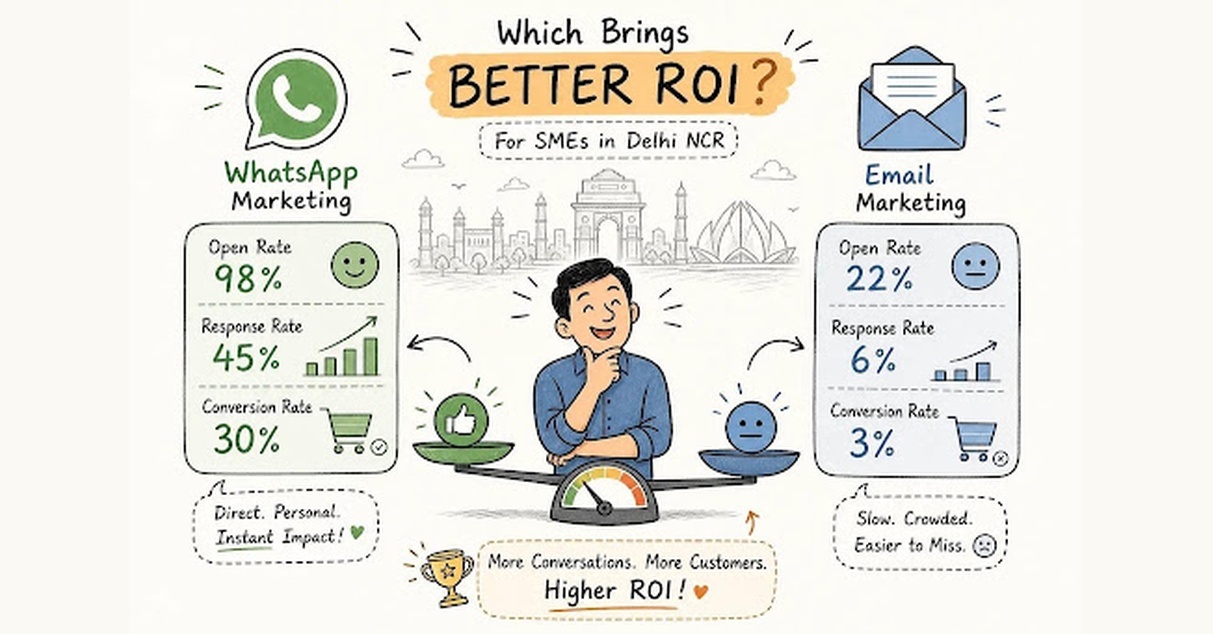
WhatsApp marketing delivers materially better ROI than email for most Delhi NCR SMEs sending promotional and transactional messages, and on most short-cycle, time-sensitive metrics such as replies, click-through rate, and cart recovery, the gap is decisive. WhatsApp open rates run at 90–98% (measured against delivered messages), while Indian business email open rates typically fall in the 20–40% range depending on list health and automation maturity. Click-through rates on WhatsApp promotional campaigns range from 15–30% against email’s 2–5%. If your goal is immediate revenue impact, abandoned-cart recovery, or lead pre-qualification, WhatsApp wins clearly and consistently across these metrics.
Email is not dead; it earns its place for long-form B2B nurture sequences, regulatory communications that require a written record, and content-heavy newsletters where depth matters. The question for businesses in Delhi NCR is not which channel to use, but which channel to use for which job. The data tells a consistent story, and this guide breaks it down so you can make that call with confidence.
Key takeaways
- Open rate gap is decisive: WhatsApp opens at 90–98%; email open rates for Indian businesses typically range from 20–40% depending on list health, making WhatsApp significantly more reliable for time-sensitive messages.
- Campaign types matter: Broadcasts, drip sequences, abandoned-cart flows, and catalogue commerce are WhatsApp’s strongest formats; email wins for long-form nurture and regulatory content.
- Platform choice unlocks scale: The free WhatsApp Business app caps broadcasts at 256 contacts; the API removes that ceiling and enables CRM integration and automation.
- Opt-in compliance is non-negotiable: WhatsApp policy and India’s DPDP Act, 2023 both require explicit, affirmative consent; a customer messaging you first does not count as consent for future campaigns.
- Measure what moves revenue: Track reply rate, qualified-lead rate, and cost per acquisition rather than open rate, which is almost always high on WhatsApp regardless of campaign quality.
- Blended strategy outperforms either alone: Use WhatsApp for short-cycle conversion; use email for longer decision cycles and content sequences where the inbox is the natural format.
WhatsApp marketing vs email: what the metrics actually show for Indian SMEs
Open rates, CTR and conversion benchmarks side by side
The headline numbers are straightforward, but the denominator matters as much as the figure itself. A WhatsApp open rate of 90–98% is measured against delivered messages; email open rates in the 20–40% range are measured the same way, yet the gap in practice is enormous.
| Metric | ||
| Open / read rate | 90–98% | 20–40% (Indian businesses; varies by list health) |
| CTR, general promotional | 15–30% | 2–5% |
| CTR, e-commerce offers | 25–45% | 1.5–2.5% |
| Abandoned-cart recovery | 18–28% | 1.5–3% (automated flows) |
Actual results vary by list quality, segment, and campaign type. WhatsApp marketing is usually more expensive per message: Meta charges approximately ₹0.8631 per marketing message for Indian businesses (per Meta’s published India conversation-based pricing), which is substantially higher than bulk email delivery costs. The cost-per-qualified-lead advantage for WhatsApp comes from faster responses and higher conversion rates, not from lower media cost. Always compare channels at the qualified-lead or revenue level, not at the cost-per-message level.
Where email marketing still earns its place
Email genuinely outperforms WhatsApp for long-form content: detailed case studies, product
documentation, weekly newsletters, and enterprise B2B sequences where decision-makers prefer the inbox for considered reading. Regulatory and financial communications also belong in email, where there is a clear audit trail. For SMEs targeting high-ticket B2B accounts with decision cycles measured in weeks or months, a blended strategy that uses WhatsApp for rapid follow-up and email for deeper nurture consistently outperforms either channel used in isolation.
WhatsApp marketing campaign types that convert
Broadcasts, drip sequences and promotional messages
Broadcast campaigns on WhatsApp are permission-based, template-driven, and segmented by behaviour or purchase history. A well-structured welcome drip might open with an immediate greeting and a single preference question using quick-reply buttons, say, product category options, follow with a relevant set of recommendations, and close 12–24 hours later with a first-purchase incentive if no order has been placed. Keeping one clear call to action per message, such as “Complete order” or “View products,” rather than several competing links, is consistently more effective.
Segmentation and language localisation make a significant difference to WhatsApp marketing campaign performance. Industry case studies have reported CTR increases of around 40% from Hinglish messaging compared to English-only messages, illustrating that personalising both the audience segment and the language register is worth the additional setup time. Generic blasts to an unsegmented list underperform personalised broadcasts on every metric that matters.
Chatbots, catalogue messages and abandoned-cart reminders
WhatsApp automation and chatbots handle the routine objections that slow down purchase decisions, sizing queries, delivery timelines, cash-on-delivery availability, return policies, keeping response times instant and reducing the load on your sales team. A practical abandoned-cart sequence runs in three steps: a help-first reminder at 45–60 minutes after cart abandonment, an objection-handling or incentive message at 12–24 hours, and a low-pressure urgency message at 48–72 hours with an easy opt-out.
For D2C brands, WhatsApp catalogue messages enable in-chat product browsing, and connecting a supported UPI payment gateway through a BSP platform lets customers complete a purchase without leaving the conversation. This reduction in friction between product discovery and checkout is one of WhatsApp’s most compelling advantages over email, where every step typically redirects the user to an external browser.
WhatsApp Business app or API: which one does your business need?
The free app and why it limits growth quickly
The WhatsApp Business app is free, quick to set up, and perfectly adequate for a micro-business testing the channel with a small contact list. The limitations become a bottleneck rapidly: broadcasts are capped at 256 contacts, automation is minimal, and the account cannot integrate with a CRM or support multiple agents simultaneously. In practice, this means you cannot trigger automated flows from external events, cannot assign conversations to different team members, and cannot track campaign performance in any structured way. Once your opted-in list grows beyond a few hundred contacts, the app actively constrains campaign performance.
Choosing between the Cloud API and a BSP platform
There are two routes to WhatsApp Business API access: the direct Cloud API, which requires developers to configure webhooks, authentication, and message handling; and a Business Solution Provider (BSP) platform, which provides a no-code dashboard and handles the technical layer for you. For most local startups and growing SMEs, a BSP is the faster and more practical path.
| Platform | Best suited for | Starting price (approx.) | Standout feature |
| WatEase | D2C brands needing UPI checkout | Custom quote | In-chat UPI checkout and GST invoicing |
| Gupshup | Enterprises and high-volume API | Volume-based | Developer-grade API and omnichannel CPaaS |
Platform fees are only one part of the cost: Meta’s per-message charge of approximately ₹0.8631 per marketing message (per Meta’s published India pricing) applies separately from the subscription. API setup for an Indian business typically takes 3–10 business days when documents are in order; complex verification cases can extend this to three weeks. Documents to prepare in advance include your GST certificate, PAN, and certificate of incorporation. Ensure these details match exactly across your PAN, GST records, Meta Business Manager, and your WhatsApp display name, mismatches are the most common cause of verification delays.
How to run compliant WhatsApp campaigns without risking your account?
Opt-in rules and what actually counts as consent
WhatsApp’s official 2026 policy is clear: a business may message someone only if it holds both their number and their explicit opt-in to receive WhatsApp messages. A customer messaging your business first does not constitute consent for future proactive campaigns. India’s Digital Personal Data Protection Act, 2023 adds another layer: consent must be free, specific, informed, and given through clear affirmative
action. A pre-ticked checkbox or a general “communications” opt-in at checkout is not sufficient. Practical opt-in collection methods for businesses in the region include:
- Website forms with an explicit, separate WhatsApp marketing checkbox
- Click-to-WhatsApp ads followed by an in-chat opt-in confirmation
- Checkout opt-ins with clearly named purpose
- QR codes at physical touchpoints
Keep records of who consented, when, and through which channel, the business bears the burden of demonstrating valid consent under both WhatsApp policy and the DPDP Act. Make withdrawal as simple as replying “STOP,” and honour opt-outs promptly.
Template approval, the 24-hour window, and what to avoid
Any message your business initiates outside an active conversation must use a Meta-approved message template. Template approval typically takes minutes to 48 hours, though some reviews take longer. Once a customer replies, a 24-hour customer-service window opens during which you can send free-form messages; outside that window, only approved templates can initiate contact. Submit utility, authentication, and marketing templates separately, and use each template only for its approved purpose.
The prohibited content list includes financial account numbers, government ID numbers, gambling promotions directed at under-18s, and any content that misleads, spams, or deceives. For compliant campaigns, collect only the data you need, stop promotional sequences immediately after a purchase or unsubscribe, and ensure your business identity is clearly stated at the point of opt-in.
Inside a Gurgaon startup’s WhatsApp drip: how the approach works in practice
The problem: paid ads generating volume but not qualified leads
Consider a service startup in Gurgaon running Google and Meta ads that generate a reasonable volume of form submissions. Lead quality is inconsistent: the sales team spends significant time on calls with prospects outside the target budget or timeline, and the cost per qualified lead rises quarter on quarter.
The business needs a way to pre-qualify and warm leads before a sales call, without adding headcount. Industry benchmarks show this pattern is common among service-sector SMEs across the region.
How a WhatsApp drip rebuilds the top of the funnel
One structured approach to this challenge starts with WhatsApp Business API setup on a dedicated number, integrated with the existing lead capture form. A three-message drip triggers immediately after form submission. Message one delivers a concise value statement and asks a single qualifying question via quick-reply buttons covering budget range and timeline. Message two, sent after the reply, matches relevant service information to the customer’s stated response. Message three, sent 24 hours later for non-responders, offers a brief introductory call with a specific agenda so the prospect knows exactly what to expect.
Designing all template messages to pass Meta’s approval requirements, alongside a performance dashboard tracking delivered, replied, qualified, and booked rates at each stage, creates a repeatable, measurable system. Businesses running WhatsApp marketing campaigns structured this way, with proper segmentation and a qualifying drip, typically see reply rates in the 15–30% range and improved qualified-lead ratios that the broader WhatsApp benchmark data supports.
How to measure WhatsApp marketing ROI and know if it is actually working
The metrics that matter beyond open rate
Open rate on WhatsApp is nearly always high; it should not be your primary optimisation lever. The metrics that reveal genuine performance are reply rate (a signal of message relevance), qualified-lead rate (replies that meet your defined criteria), click-to-checkout conversion, revenue per delivered message, opt-out rate (rising opt-outs signal poor targeting or excessive frequency), and cost per acquisition compared to your email or paid-ad baseline. When vendors report 45–60% “conversion” without defining the denominator, they are almost always measuring clicks, replies, or chat starts rather than completed sales.
Building a simple reporting framework for your business
A practical monthly reporting template should capture campaign name, audience segment, messages sent, delivered, read, replied, clicked, converted, revenue attributed, opt-outs, and total cost (platform subscription plus Meta message charges). Compare each campaign against a holdout group or your previous channel baseline to establish true incrementality, not just raw performance. Run A/B tests on English versus Hinglish copy, discount offers versus free delivery, and single-message blasts versus multi-step drip sequences. After several weeks of consistent data collection, enough to reach statistical significance given your send volume, the patterns become clear enough to allocate budget with real confidence.
The verdict: align each channel with what it does best
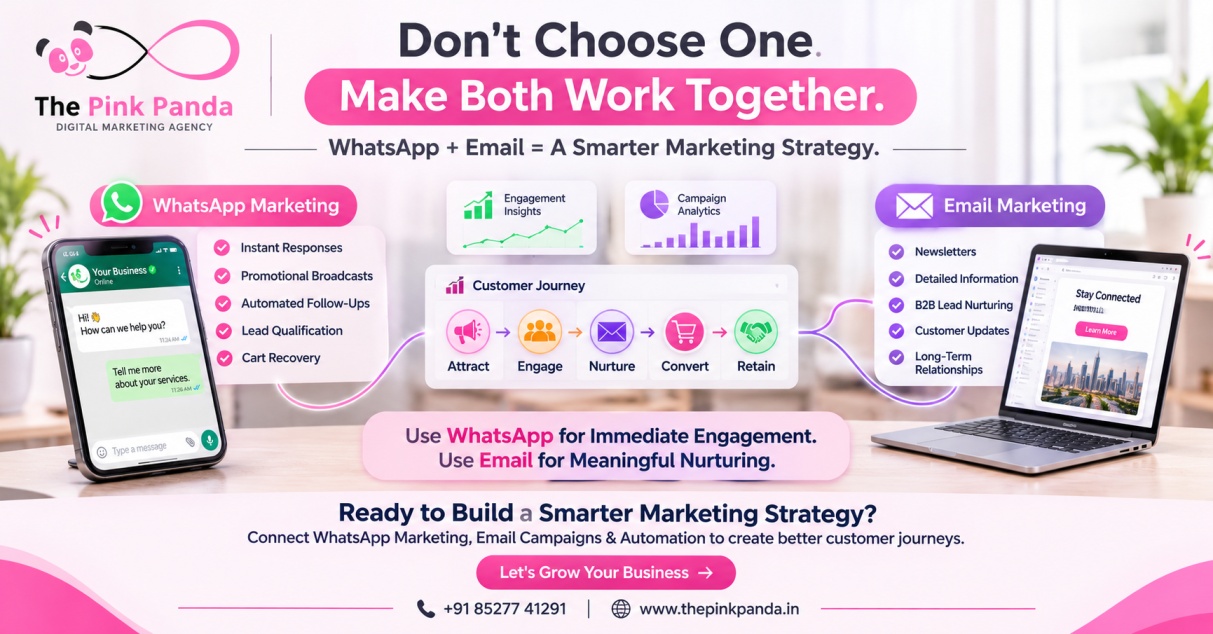
For Delhi NCR SMEs running promotional campaigns, time-sensitive offers, abandoned-cart recovery, and lead pre-qualification, WhatsApp marketing delivers measurably better ROI than email on most short-cycle metrics. Email remains the right tool for longer B2B nurture, regulatory communications, and content-heavy sequences where considered reading is the expected behaviour. The smartest approach is not to choose one and abandon the other: it is to match each channel to the job it performs best.
If WhatsApp marketing is new territory for your business, getting the API access, platform selection, template design, and drip logic right from the start saves weeks of trial and error. That is exactly where a specialist team can make a difference. The Pink Panda offers digital marketing support for SMEs and startups across Delhi NCR. If you are ready to run your first revenue-focused WhatsApp campaign, get in touch with our team and we will build the strategy with you.
Frequently Asked Questions
How much does WhatsApp marketing cost per message for Indian businesses?
WhatsApp marketing messages cost approximately ₹0.8631 per marketing message for Indian businesses according to Meta’s published India conversation-based pricing. This charge is separate from any BSP subscription or platform fees, so you should compare channels at the qualified-lead or revenue level rather than per-message cost alone.
If a customer messages our business first, does that count as consent for future campaigns?
No, a customer messaging your business first does not constitute consent for future proactive campaigns under WhatsApp policy. You must obtain explicit, affirmative opt-in and keep records of who consented, when, and through which channel to comply with both WhatsApp rules and India’s DPDP Act, 2023.
Which platform route should our SME pick: Cloud API or a BSP platform?
For most local startups and growing SMEs a BSP platform is the faster and more practical path compared with configuring the Cloud API yourself. A BSP provides a no-code dashboard and handles the technical layer, while the Cloud API requires developers to configure webhooks, authentication and message handling.
What documents do we need to prepare for WhatsApp Business API verification?
Prepare your GST certificate, PAN, and certificate of incorporation, ensuring these details match exactly across your PAN, GST records, Meta Business Manager and your WhatsApp display name. Mismatches are the most common cause of verification delays, and API setup typically takes 3–10 business days when documents are in order.
How should we let customers opt out of WhatsApp campaigns and how quickly must we honour it?
You should make withdrawal simple, for example by allowing customers to reply “STOP,” and you must honour opt-outs promptly. Rising opt-out rates are a signal of poor targeting or excessive frequency, so stop promotional sequences immediately after an unsubscribe.
#WhatsAppMarketing #EmailMarketing #WhatsAppVsEmailMarketing #WhatsAppMarketingROI #DigitalMarketing #SMEMarketing #SmallBusinessMarketing #WhatsAppBusinessAPI #MarketingAutomation #LeadGeneration #CustomerEngagement #ConversionOptimization #DelhiNCRBusiness #DigitalMarketingDelhiNCR #ThePinkPanda